

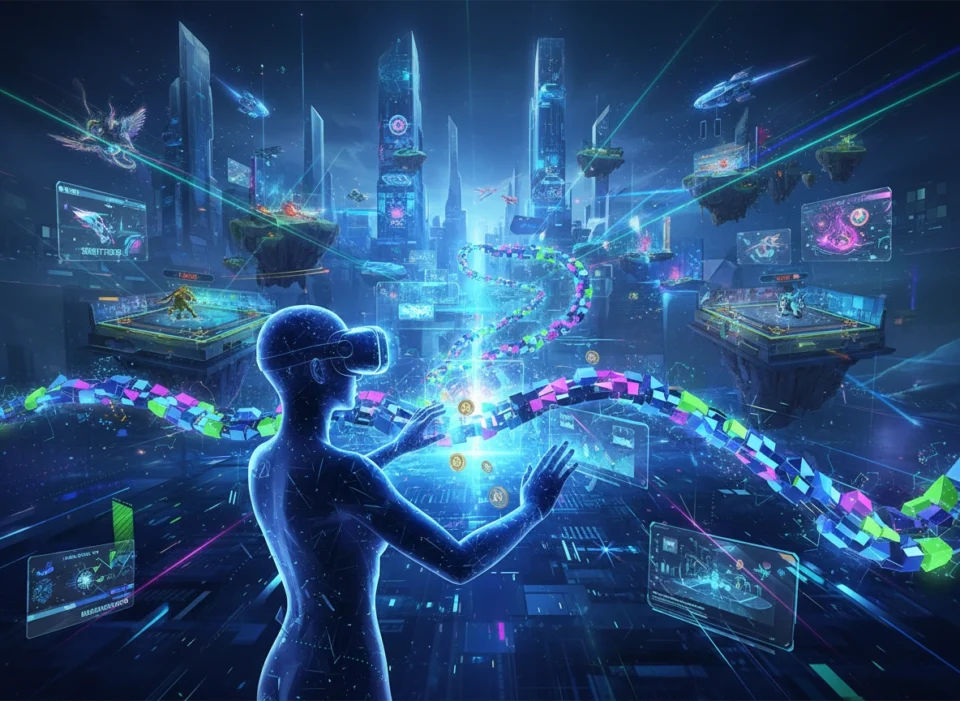
The online gaming industry is undergoing a monumental shift, driven by a technology poised to redefine the very fabric of digital interaction: blockchain. For decades, players have invested countless hours and significant money into virtual worlds, accumulating assets that exist only within the confines of a single game’s centralized server. Blockchain technology challenges this paradigm, introducing a future where players have true ownership of their in-game items, economies are transparent, and trust between developers and communities is programmatically guaranteed. This evolution promises to transform gaming from a closed ecosystem into an open, interconnected digital frontier.
This article explores the profound impact of blockchain on online gaming. We will examine how it enhances security and transparency, discuss the revolutionary concept of true player ownership through Non-Fungible Tokens (NFTs), and consider the potential for fully decentralized gaming platforms. By looking at current trends and future possibilities, we can begin to understand how this technology is building a more equitable and engaging world for gamers.
Enhancing Security and Transparency
At its core, blockchain is a distributed, immutable ledger. This structure offers a powerful solution to some of gaming’s most persistent problems: fraud, account hacking, and a lack of transparency in game economies.
In traditional online games, all data—from player accounts to item inventories—is stored on centralized servers controlled by the developer. These servers are single points of failure, making them attractive targets for hackers. A successful breach can lead to stolen accounts, duplicated items that crash the in-game economy, and a significant loss of trust.
Blockchain technology mitigates these risks by decentralizing data storage. Player assets and transaction histories are recorded across a network of computers, making it nearly impossible for a malicious actor to alter them. Every transaction is cryptographically secured and verified by the network, creating a transparent and tamper-proof record of ownership and exchange. This foundational security allows players to trade high-value items with confidence, knowing their assets are protected by the integrity of the blockchain itself.
Furthermore, blockchain introduces unparalleled transparency to in-game economies. Developers can program “smart contracts”—self-executing contracts with the terms of the agreement directly written into code—to govern the creation and distribution of in-game items. This means the rarity of a legendary sword or a unique cosmetic skin is no longer just a claim by the developer; it is a verifiable fact on the blockchain. Players can independently audit the total supply of any item, ensuring that developers cannot secretly mint more to devalue existing ones. This level of transparency fosters a new era of trust, where the rules of the game world are clear and fair for everyone.
The Revolution of True Player Ownership: NFTs
Perhaps the most significant innovation blockchain brings to gaming is the concept of true digital ownership, made possible by Non-Fungible Tokens (NFTs). Unlike cryptocurrencies like Bitcoin, which are fungible (interchangeable), each NFT is unique and cannot be replaced. When applied to gaming, an NFT can represent any distinct in-game asset: a character, a weapon, a piece of armor, or even a plot of virtual land.
From License to Ownership
In the traditional gaming model, when you “buy” an in-game item, you are essentially purchasing a license to use it within the developer’s controlled environment. You do not truly own it. If the developer shuts down the game servers or bans your account, those assets are lost forever.
NFTs fundamentally change this relationship. When an in-game item is minted as an NFT on a blockchain, the player who acquires it gains verifiable ownership. The item is stored in their personal crypto wallet, completely independent of the game developer’s servers. This means the player can sell it on a third-party marketplace, trade it for other assets, or even use it in different games that support the same blockchain standard. This asset is theirs to keep, even if the original game ceases to exist.
Creating Interoperable Universes
The concept of using an NFT asset across multiple games is known as interoperability, and it represents a holy grail for the future of gaming. Imagine owning a unique, powerful sword in a fantasy RPG. With blockchain, you could potentially equip that same sword on your character in a different fighting game or display it as a trophy in your virtual home on a social platform.
While full interoperability faces technical and design challenges, its potential is immense. It could lead to a “metaverse” where a player’s digital identity and possessions persist across a vast network of interconnected virtual worlds. This would create immense value for players, as the time and money they invest in one game could yield benefits across their entire digital life.
Decentralized Gaming Platforms and Player-Run Economies
Beyond individual assets, blockchain technology paves the way for entirely decentralized games. Decentralized Autonomous Organizations (DAOs) are a key part of this vision. A DAO is an organization represented by rules encoded as a computer program that is transparent, controlled by the organization members, and not influenced by a central government.
In a gaming context, a DAO could allow players to have a direct say in the development and governance of the game they play. Holders of the game’s governance token could vote on proposals, such as balancing changes, new content additions, or how treasury funds are spent. This model shifts power from a central developer to the community, creating a truly player-driven experience. Games become less like products consumed by players and more like digital nations governed by their citizens.
This decentralized structure also fosters player-run economies. With assets secured as NFTs and transactions managed by smart contracts, players can create their own marketplaces, lending services, and crafting businesses within the game world. The economy becomes a dynamic, emergent system driven by player supply and demand, rather than being dictated by the developer. This can lead to new forms of gameplay centered on entrepreneurship and economic strategy, providing careers for players who become master crafters, skilled traders, or savvy financiers within the virtual world.
The Road Ahead: Challenges and Future Possibilities
Despite its immense potential, the integration of blockchain in gaming is not without its challenges. High transaction fees and slow processing times on some blockchains, known as “gas fees” and scalability issues, can hinder the fast-paced experience gamers expect. The user experience of managing crypto wallets and interacting with blockchain protocols can also be complex for newcomers. Furthermore, there is ongoing debate about the environmental impact of certain blockchain technologies.
However, the industry is rapidly innovating to solve these problems. New “Layer 2” scaling solutions are emerging to make transactions faster and cheaper. Developers are creating more user-friendly interfaces that abstract away the complexities of blockchain, making it seamless for players to engage with NFTs and decentralized systems. More energy-efficient “Proof-of-Stake” blockchains are also becoming the standard, addressing environmental concerns.
Looking forward, the possibilities are thrilling. We may see games where the storyline is dynamically altered by player votes within a DAO. In-game achievements could be minted as “soulbound” NFTs, creating a permanent, verifiable record of a player’s gaming history. Esports could be transformed, with prize pools managed transparently by smart contracts and player winnings paid out instantly.
The integration of blockchain technology is set to build a more rewarding, equitable, and persistent future for online gaming. It is a shift from renting digital items to truly owning them, from being a passive consumer to an active participant in the game’s governance and economy. While the road to mass adoption is still being paved, the foundation has been laid for a new generation of games built on trust, ownership, and community.
Please visit this website for more info.
