
The world of finance is often filled with jargon that sounds more like a foreign language than a description of money management. One term that frequently confuses newcomers is “tranche.” While it sounds sophisticated—it comes from the French word for “slice” or “portion”—the concept itself is surprisingly logical once you break it down.
If you have ever heard news reports about the 2008 financial crisis, mortgage-backed securities, or complex investment products, you have likely heard this word. But what exactly is a tranche? Why do they exist? And how do they affect the financial ecosystem?
This article will peel back the layers of this financial concept, explaining how tranches work, why they are used, and their role in the broader economy.
What is a Tranche?
At its core, a tranche is simply a specific slice of a larger pool of securities. When banks or financial institutions bundle together a group of loans—like mortgages, auto loans, or credit card debt—they don’t always sell that bundle as a single, uniform product. Instead, they slice it up into different sections. These sections are the tranches.
Think of it like a layer cake. The whole cake represents a massive pool of debt (thousands of mortgages, for example). But not everyone wants the same piece of cake. Some investors want the safest, most stable layer, even if it is a bit plain. Others want the layer with the rich, sweet frosting, even if it might give them a stomach ache later.
In financial terms, tranches allow a single pool of debt to be divided into different classes of securities, each with its own level of risk, reward, and maturity.
The Risk-Reward Trade-off
The primary reason for creating tranches is to manage risk. Not all investors have the same appetite for risk. A pension fund, which needs to ensure it has money for retirees in 30 years, is generally very conservative. A hedge fund, on the other hand, might be willing to take a big gamble for the chance of a massive return.
Tranching allows financial engineers to take a pool of loans and create products that appeal to both of these investors simultaneously.
- Senior Tranches: These are the safest slices. They get paid first. If the borrowers in the pool start paying back their loans, the investors in the senior tranche get their money before anyone else. Because they are safer, they offer a lower interest rate (yield).
- Mezzanine Tranches: These sit in the middle. They carry more risk than senior tranches but less than the bottom layers. They get paid only after the senior tranche has been satisfied. To compensate for this extra risk, they offer a higher yield.
- Junior (or Equity) Tranches: These are the riskiest slices. They get paid last. If borrowers default on their loans, the losses hit this tranche first. If too many people stop paying, the junior tranche investors might lose everything. However, if everyone pays as agreed, these investors earn the highest returns.
How Tranches Work: The Waterfall Metaphor
To visualize how money flows through these slices, financial experts often use the “waterfall” metaphor.
Imagine a cascading waterfall with three buckets arranged vertically.
- The Top Bucket (Senior Tranche): The water (cash flow from people paying their mortgages) hits this bucket first. It fills up until the investors in this tranche have received their promised interest and principal payments.
- The Middle Bucket (Mezzanine Tranche): Only after the top bucket is completely full does the water spill over into the middle bucket.
- The Bottom Bucket (Junior Tranche): This bucket only catches water if there is enough flow to fill the first two buckets completely. If there is a drought (many borrowers default), the water might stop flowing before it ever reaches this bottom bucket.
This structure provides protection for the senior investors. The junior investors act as a “shock absorber,” soaking up the first losses so the senior investors don’t have to.
Where Are Tranches Used?
Tranching is most commonly associated with structured finance and securitization. This is the process of taking illiquid assets (like a single home mortgage that is hard to sell to an investor) and turning them into liquid securities (like a bond that can be traded easily).
Mortgage-Backed Securities (MBS)
The most famous example of tranching occurs in Mortgage-Backed Securities (MBS). Banks issue mortgages to homeowners. Instead of holding those loans for 30 years, they bundle thousands of them together and sell them to a specialized entity. This entity then slices the bundle into tranches and sells them to investors.
Example:
Imagine a pool of mortgages worth $100 million.
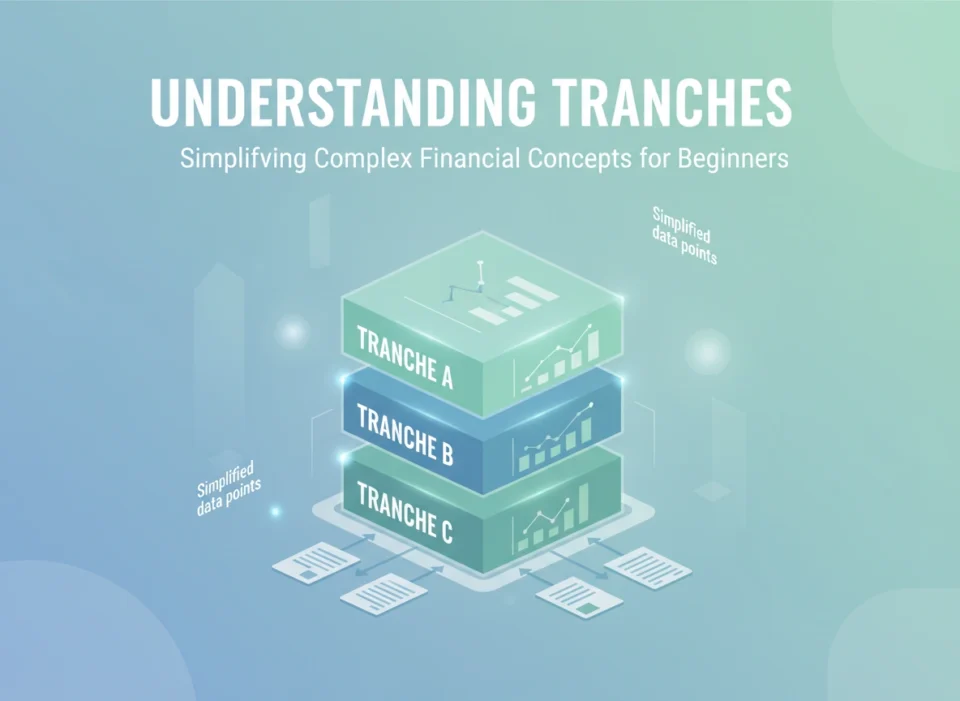
- Tranche A (Senior): Rated AAA. These investors are promised a 3% return. They are the first to be paid from the homeowners’ monthly mortgage checks.
- Tranche B (Mezzanine): Rated BBB. These investors are promised a 5% return. They only get paid after Tranche A is current.
- Tranche C (Equity): Unrated or “Junk” status. These investors are promised a 10% return. They take the first hit on any defaults.
If 2% of the homeowners default, the losses are absorbed entirely by Tranche C. Tranche A and B investors might not even notice. However, if 15% of homeowners default, Tranche C is wiped out, Tranche B takes heavy losses, and Tranche A might finally start to see some reduction in payments.
Collateralized Debt Obligations (CDOs)
A Collateralized Debt Obligation (CDO) takes this concept a step further. While an MBS is usually backed by mortgages, a CDO can be backed by a mix of assets—corporate loans, credit card debt, auto loans, or even tranches of other mortgage-backed securities.
The logic remains the same. The CDO manager slices the risk into tranches to attract different types of investors. The complexity of CDOs, specifically those composed of the riskier tranches of subprime mortgages, played a significant role in the 2008 financial crisis. The complexity made it difficult for investors (and rating agencies) to understand exactly what was in the “underlying pool” of assets. They assumed the Senior Tranches were safe because they were rated AAA, but when the entire housing market collapsed, the “waterfall” dried up completely.
The Benefits of Tranching
Despite the bad reputation gained during the financial crisis, tranching serves legitimate and vital purposes in the modern economy.
1. Increased Liquidity
By creating securities that fit different risk profiles, banks can sell their loans to a wider range of investors. This frees up capital for the banks, allowing them to lend more money to people who want to buy homes or start businesses.
2. Customized Investment
Tranching allows investors to fine-tune their portfolios. An insurance company can buy senior tranches for safety, while a hedge fund can buy junior tranches for potential profit. Without tranches, these investors might not participate in the mortgage market at all.
3. Risk Distribution
Ideally, tranching spreads risk across the financial system rather than keeping it concentrated in one bank. If a bank holds all its own mortgages and the local economy crashes, the bank fails. If those mortgages are securitized and tranched out to global investors, the loss is dispersed.
The Risks and Criticisms
While beneficial, the system is not perfect. The primary danger of tranching is complexity.
- Opacity: When loans are bundled and sliced, it becomes very hard to see the quality of the individual loans inside the pool. An investor buying a tranche is relying heavily on the accuracy of the mathematical models and the credit rating agencies.
- Correlation Risk: The models used to create tranches often assume that not everyone will default at the same time. For example, if you lend money to 1,000 people across the country, you assume their ability to pay is unrelated. But if a national recession hits or housing prices crash everywhere at once (as happened in 2008), defaults become “correlated.” When that happens, the safety protections built into the senior tranches can fail.
- Mispricing Risk: Because junior tranches are complex and risky, they are hard to price accurately. Investors might underestimate the risk they are taking for the yield they are getting.
Summary: The Slice Matters
Understanding tranches is essential for understanding how modern credit markets function. They are the mechanism that transforms a messy pile of individual debts into organized investment products.
Just remember the cake analogy. When you buy a financial product that has been “tranched,” you aren’t buying the whole cake. You are buying a slice. That slice determines when you get paid, how much you get paid, and how likely you are to lose your money if things go wrong.
Whether you are a student of finance or just trying to understand the news, knowing the difference between the “Senior” slice and the “Equity” slice is the key to decoding the complex world of structured finance.Please click here for more info.
You may also read: Top 10 Unique Dog Names to Strengthen Your Bond with Your Pet
