
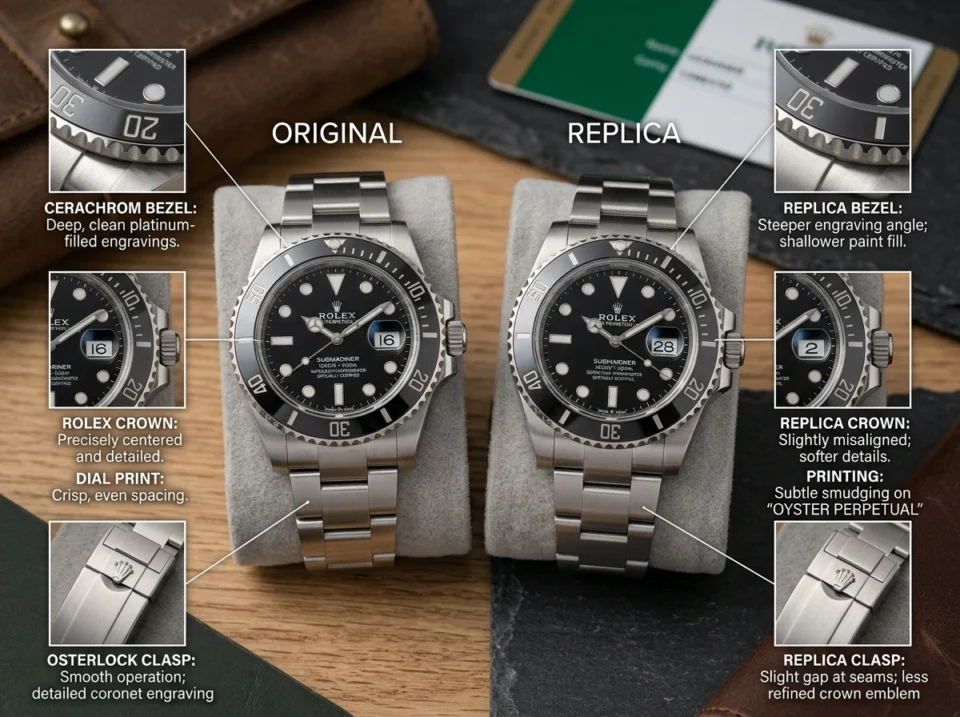
The Rolex Submariner stands as one of the most recognized luxury watches on the planet. Its clean design, deep diving heritage, and status as a symbol of success make it a target for both collectors and counterfeiters. As replica quality continues to climb, telling a fake apart from the real thing has become a genuine challenge, even for seasoned enthusiasts.
If you’re shopping for a Submariner in the United States, whether through an authorized dealer, a private seller, or the secondary market, knowing what to look for protects your wallet and your peace of mind. This detailed visual comparison walks you through the key areas where replicas and originals diverge. By the end, you’ll have a sharper eye for the small details that separate a craft masterpiece from a clever imitation.
Why Visual Inspection Still Matters
Modern replicas have come a long way. Some high-end fakes use similar weight, comparable materials, and convincing dials. Still, no replica perfectly matches the precision Rolex applies to every component. The brand obsesses over tolerances measured in fractions of a millimeter, and that level of control is hard to fake at scale.
A careful side-by-side look remains one of the most reliable ways to assess authenticity before you spend serious money. Pay attention to consistency, alignment, and finishing. These are the areas where corners get cut. For those researching the market further, resources covering the Replica rolex submariner landscape can offer helpful context on how these imitations are made and marketed.
The Dial: Where Fakes Often Slip
The dial is usually the first place experts examine, and for good reason.
Text Sharpness and Spacing
On a genuine Submariner, the printed text is crisp, evenly spaced, and perfectly aligned. Look closely at the “ROLEX” name and the model line beneath it. Authentic dials show clean edges with no bleeding or fuzziness. Many replicas reveal slightly blurry printing or uneven letter spacing under magnification.
The Coronet Logo
Rolex applies its crown logo with remarkable precision. The five points should be symmetrical and well-defined. Fakes often produce a coronet that looks slightly squished, lopsided, or thicker than it should be.
Lume Application
Genuine Submariners use Chromalight lume that glows a steady blue and is applied with clean, uniform borders. Replica lume can appear sloppy at the edges, glow a greenish tint, or fade quickly. Examine the hour markers and hands in low light to compare brightness and consistency.
The Bezel: Action and Detail
The rotating bezel is both functional and a strong authenticity indicator.
Clicks and Rotation
An authentic Submariner bezel rotates in one direction with 120 precise clicks. The action feels firm and deliberate, with no wobble or play. Many replicas feel loose, gritty, or rotate too easily, sometimes with fewer clicks.
Insert Quality
Rolex uses a Cerachrom ceramic bezel insert that resists scratching and fading. The numerals and markings are engraved and filled, then polished to a smooth finish. On fakes, you may notice printed numbers, slightly off-center alignment, or a finish that feels cheaper to the touch. The luminous pearl at the 12 o’clock position should sit evenly within its surround on a genuine piece.
The Case: Proportions and Finishing
Rolex machines its cases from solid blocks of 904L stainless steel, known as Oystersteel. This alloy resists corrosion and holds a polish exceptionally well.
Weight and Feel
A real Submariner carries noticeable heft. The balance feels substantial without being awkward. Lighter replicas often use lower-grade steel, which can feel hollow or tinny by comparison.
Brushing and Polishing
Examine the transitions between brushed and polished surfaces. On an authentic case, these lines are sharp and deliberate. The lugs are evenly shaped and the edges are clean. Replicas frequently show softer transitions, uneven brushing, or polish that bleeds into areas meant to be matte.
Engravings
Genuine Rolex models feature laser-etched engravings between the lugs, including a tiny coronet visible only under magnification on the crystal at 6 o’clock. Fakes either skip these details or reproduce them imperfectly.
The Crown and Crown Guards
The winding crown is a small part with big implications.
On the original, the Triplock crown screws down smoothly and seals tightly for water resistance. The coronet engraved on the crown is clean and properly proportioned. The crown guards that flank it are symmetrical and machined as part of the case.
Replicas often struggle here. The crown may thread roughly, sit at an odd angle when tightened, or display a poorly formed logo. Crown guards on fakes can look uneven or slightly misaligned.
The Bracelet and Clasp
The Oyster bracelet is a hallmark of the Submariner experience.
Link Construction
Authentic bracelets feel solid, with tight tolerances and minimal rattle. The links move smoothly. Many replicas produce a bracelet that feels flimsy, rattles loudly, or shows visible gaps between links.
The Clasp
Rolex clasps feature precise engravings, a smooth-operating Glidelock or comparable extension system, and a satisfying, secure snap. The coronet stamped into the clasp should be crisp. On fakes, the clasp may feel cheap, the engraving may look shallow, and the locking mechanism can feel loose or imprecise.
The Movement: The Hardest Part to Fake
Inside the watch lies the strongest evidence of authenticity.
Genuine Submariners house Rolex in-house automatic movements, finely finished and certified as chronometers. The seconds hand sweeps smoothly with a high beat rate. While most replicas hide a generic automatic movement, some now mimic the sweep convincingly. Even so, the finishing, accuracy over time, and reliability rarely match.
Reputable jewelers and watchmakers can open the case to inspect the movement. An authentic Rolex caliber shows refined decoration, proper engravings, and components built to last decades. If a seller refuses to allow a professional inspection, treat that as a warning sign.
Quick Comparison Checklist
|
Feature |
Genuine Submariner |
Common Replica Flaw |
|---|---|---|
|
Dial text |
Crisp, even, aligned |
Blurry or uneven spacing |
|
Coronet logo |
Symmetrical, defined |
Squished or thick |
|
Bezel |
120 firm clicks |
Loose, fewer clicks |
|
Case finish |
Sharp transitions |
Soft, bleeding polish |
|
Crown |
Smooth Triplock seal |
Rough threading |
|
Bracelet |
Solid, tight links |
Rattly, flimsy |
|
Movement |
In-house, smooth sweep |
Generic caliber |
Protecting Your Investment
A Rolex Submariner is a significant purchase, often crossing well into five figures on the US market. That price reflects decades of engineering, craftsmanship, and brand heritage. Buying smart means doing your homework.
Always favor authorized dealers or established, reputable sellers. Ask for original paperwork, the warranty card, and the box. Request high-resolution photos of every detail described above. When in doubt, pay a certified watchmaker to authenticate the piece before money changes hands. The small cost of an inspection is nothing compared to the loss of buying a convincing fake.
Final Thoughts
The gap between a replica and a genuine Rolex Submariner lives in the details. The dial printing, the bezel action, the case finishing, the crown threading, the bracelet feel, and the movement inside all tell a story. Counterfeiters can copy the look, but matching Rolex’s precision across every component remains out of reach.
Train your eye on these comparison points, take your time, and never rush a luxury watch purchase. With knowledge and patience, you can shop with confidence and own a Submariner you trust completely, one that holds its value and its prestige for years to come.
