

Building authority in the adult entertainment industry requires a careful, strategic approach to search engine optimization. Unlike mainstream niches, this space faces strict regulations, limited advertising options, and highly competitive search engine results pages. Because traditional marketing avenues are often closed off, organic search visibility becomes the primary driver of consistent, high-quality traffic.
One of the most effective ways to build this organic visibility is through targeted link-building campaigns. Earning backlinks from established, authoritative websites signals to search engines that your domain is trustworthy and relevant. However, executing this strategy poorly can do more harm than good. Search algorithms are incredibly sophisticated and penalize manipulative or low-quality link-building tactics heavily.
Understanding the right way to approach Adult Guest Posting is critical for sustainable growth. Many marketers and website owners rush into outreach without a solid plan, wasting time and resources on placements that fail to move the needle. By identifying and eliminating common errors from your strategy, you can secure better placements, protect your website from algorithmic penalties, and ultimately drive more paying subscribers to your platform.
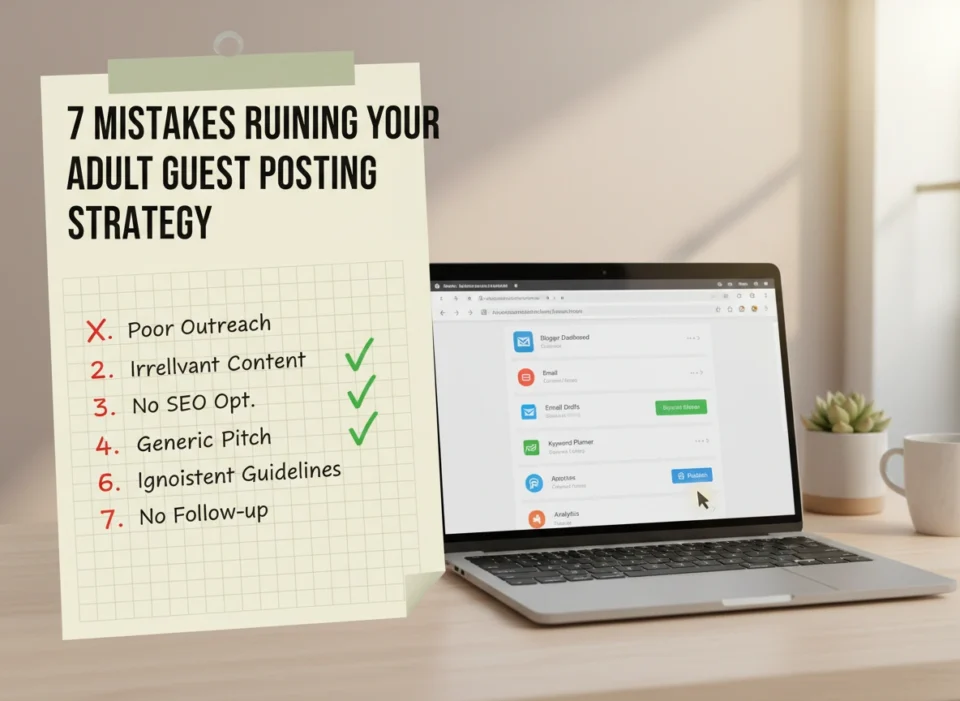
Here are the top seven mistakes you need to avoid when executing your outreach and content placement strategy.
Mistake 1: Ignoring site relevancy and quality
Securing a backlink from a website with a high Domain Authority might seem like a major win. However, if that website has nothing to do with your specific niche, the link loses a significant amount of its value. Search engines prioritize context. A link from a highly relevant, medium-authority blog often carries more weight than a link from a massive, completely unrelated news site.
When you ignore site relevancy, you tell search engines that your link profile is unnatural. Furthermore, you miss out on referral traffic. A visitor reading a blog about adult toys is highly likely to click a link to a related store. A visitor reading a blog about personal finance will ignore that same link completely.
To fix this issue, heavily scrutinize every prospect on your outreach list. Look at their recent articles, their category structure, and their general audience demographic. Ensure their metrics—like organic traffic trends and spam scores—are healthy. Quality should always take precedence over sheer quantity.
Mistake 2: Over-optimizing anchor text
Anchor text is the clickable phrasing that houses your backlink. Years ago, SEO professionals would use exact-match keywords for every single backlink they built. If they wanted to rank for “buy premium adult toys,” they used that exact phrase as the anchor text hundreds of times across different websites.
Today, this practice is a massive red flag for search engines. The Penguin algorithm update specifically targeted this type of manipulative behavior. When your backlink profile consists entirely of keyword-rich anchor text, it looks artificially constructed.
Instead of forcing exact-match keywords, focus on building a natural, diverse anchor text profile. Use a healthy mix of branded anchors (your company name), naked URLs (your exact web address), and generic phrases (like “click here” or “read this study”). Save your exact-match or partial-match keywords for the most authoritative, high-value placements, and even then, use them sparingly.
Mistake 3: Neglecting content quality and originality
Some webmasters view guest posting simply as a vehicle to deliver a backlink. This mindset leads to the creation of thin, spun, or poorly written content. They hire cheap writers or use unedited AI generation to pump out articles rapidly, hoping the target blog will publish it without a second glance.
Publishing low-quality content damages your brand reputation and drastically reduces the effectiveness of your campaign. Authoritative webmasters will immediately reject spammy submissions. Even if a lower-tier site accepts the article, search engines are adept at identifying and devaluing thin content. The link housed within that article will pass little to no equity.
Your guest posts should be just as comprehensive and engaging as the content published on your own website. Provide unique insights, reference accurate data, and format the text for easy reading. When you deliver exceptional content, webmasters are more likely to accept your pitches, share your article on social media, and welcome future contributions.
Mistake 4: Failing to research the target audience
Writing a generic article and blasting it out to fifty different blogs is a recipe for failure. Every website has a unique audience with specific pain points, interests, and reading preferences. A highly technical article about SEO strategies will flop on a casual lifestyle blog, just as a lighthearted listicle will seem out of place on a B2B industry portal.
Before you even pitch a topic, spend time analyzing the target website’s audience. Read the comments section on their popular posts to see what questions readers are asking. Note the tone of voice the site uses. Are they formal and data-driven, or conversational and edgy?
By tailoring your content to the specific audience of the host blog, you increase the chances of your pitch being accepted. More importantly, you create an article that actually resonates with readers. Engaging content keeps visitors on the page longer, generates social shares, and encourages high-quality referral clicks back to your own domain.
Mistake 5: Poor pitching and lack of professionalism
Webmasters of popular blogs receive dozens, sometimes hundreds, of pitch emails every single week. The vast majority of these emails are instantly deleted because they are poorly formatted, overly aggressive, or blatantly automated.
A terrible pitch usually starts with a generic greeting like “Dear Webmaster,” followed by a demand for a link and a list of irrelevant topics. These emails show a complete lack of respect for the editor’s time. If you approach outreach as a numbers game, sending thoughtless templates to massive lists, your success rate will be abysmal.
Professionalism is key to successful outreach. Address the editor by name. Mention a specific recent article they published and explain why you enjoyed it. Propose three highly tailored topic ideas that fill a gap in their current content library. Keep your email concise, respectful, and focused on the value you can provide to their platform, rather than the backlink you want in return.
Mistake 6: Not following webmaster guidelines
Most established websites have a dedicated “Write for Us” or “Contributor Guidelines” page. These pages outline exactly what the editor expects from a guest post submission. They might specify a minimum word count, dictate how many links you can include, or explain exactly how to format the document.
Ignoring these guidelines is the fastest way to get your submission rejected. If an editor asks for articles over 1,500 words and you submit a 500-word piece, you are showing that you do not respect their rules. If they ask for submissions in a Google Doc and you attach a PDF, you create unnecessary friction.
Always read the contributor guidelines thoroughly before crafting your pitch and before writing your article. If the guidelines forbid promotional links in the body of the text, do not try to sneak one in. Following the rules demonstrates professionalism and makes the editor’s job much easier, drastically improving your chances of publication.
Mistake 7: Ignoring internal and external linking best practices
A guest post should look and function like a natural piece of content on the host website. If the only link in a 1,500-word article points directly to your own sales page, the piece looks incredibly self-serving and promotional.
To make your article valuable and natural, you must incorporate proper internal and external linking strategies. Link to other relevant, high-quality sources to back up your claims and provide additional value to the reader. Mention industry studies, news articles, or authoritative guides.
Furthermore, take the time to link to other articles published on the host website. Editors love this because it improves their own site structure and keeps readers engaged with their content longer. By adding helpful external links and thoughtful internal links, your own backlink will blend in naturally, creating a stronger, more authoritative piece of content overall.
Best practices for long-term SEO success
Guest posting in competitive industries is not about finding shortcuts. It is about building genuine relationships with other webmasters and providing exceptional value to their readers. When you stop looking at outreach purely as a link-building transaction and start treating it as a digital PR strategy, your results will improve drastically.
Focus on quality over quantity. Five incredible articles placed on highly relevant, authoritative websites will always outperform fifty low-effort articles scattered across spammy blog networks. Take the time to research your prospects, personalize your pitches, and write content that genuinely helps the target audience.
By avoiding these seven common mistakes, you can protect your domain from algorithmic penalties and build a backlink profile that drives sustainable, long-term organic growth. Stick to these best practices, remain patient, and watch your search engine visibility climb.
